Cottage windows around Hassocks for flint and listed homes
Keymer, Clayton, Ditchling and the older lanes around them
Small windows in thick walls
Keymer's conservation area protects an 18th-century village core with flint walls and brick cottages, and Mid Sussex counts seven listed buildings inside it. Clayton has flint, painted brick and tile-hanging along Underhill Lane, and Ditchling has timber-framed houses refaced in Georgian brick.
Cottage windows are small, often with leaded lights or several panes per side, and set deep in the wall. Getting the sightlines right matters more on a small window than a large one.
Listed, protected or neither
Not listed, not in a conservation area: a slim flush casement in uPVC with the right bar pattern looks close to timber from the lane, and needs no painting.
In a conservation area: on a house, similar-looking replacements are usually allowed. Ditchling's conservation area has an Article 4 direction, so check before you order.
Listed: any alteration requires listed building consent, which normally leads to repair, a timber copy, or secondary glazing inside. For listed cottages here, secondary glazing at £450 to £1,200 (indicative) per opening is the common route.
Depending on the building (listed, conservation area, Article 4), there can be rules on the glass you're allowed and on the exact glazing-bar layout. Check with the council; Hassocks Windows can help with that process. Inside the National Park, the council to ask is the National Park Authority.
Repair first on a listed cottage
For a listed building the starting point is the window that is there now. Historic England has published guidance on traditional windows sets out how old timber casements can be repaired, draught-stripped and upgraded, and councils expect that to be considered before replacement. Rotten sills and bottom rails can often be spliced with new timber, and loose leaded panels can be re-leaded by a specialist.
Where a window is past saving, the replacement normally copies it exactly in timber, with the same section sizes, bar pattern and opening. Expect to get the brushes out about three years after a painted timber window goes in; that job falls to the owner, not the installer. Genuine timber costs a good deal more than a woodgrain uPVC lookalike, so it is worth being sure the building needs it.
Secondary glazing
When the original windows have to stay, a slim secondary window set within the reveal keeps out draughts and road noise while leaving the old frame alone. Choose one with a fine frame that lines up with the meeting rail or transom of the window behind, so it is hardly noticed from outside. It can be lifted out or slid open for cleaning and ventilation.
Local plans that mention cottages
Policy 7 of the Hassocks Neighbourhood Plan covers the Keymer and Clayton conservation areas and lists the special features to respect, including the Keymer terrace, the stone wall by the church and the use of traditional building materials. In Clayton the National Park Authority's conservation area appraisal describes the flint, brick and tile-hanging along Underhill Lane. Ditchling has its own neighbourhood plan, shared with Westmeston and Streat and made in 2018, as well as its Article 4 direction. In Hurstpierpoint, the council's conservation area appraisal asks for original timber windows to be kept wherever possible and picks out the Gothic casements on the 1830s terrace in Hassocks Road. None of this rules out new windows, but it tells you what the planners will be looking at.
Measuring a cottage window
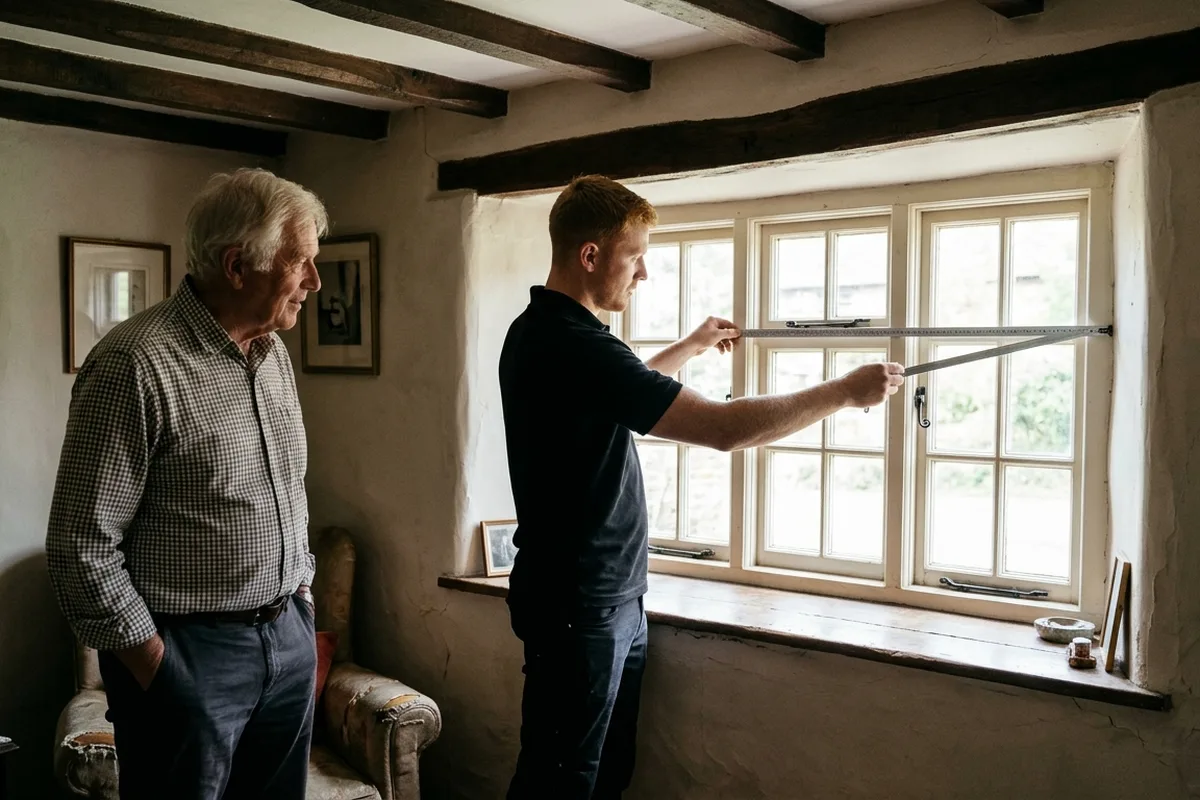
Old cottage openings are rarely square or level, and the walls can be 30 centimetres or more thick. Every window is measured individually, and the new frame is set at the same depth in the wall as the old one so the reveal and sill look unchanged. Where the internal sill is oak or slate it is kept and refitted.
Flint walls need particular care, because the flints around a window are often loosely bedded in soft lime mortar. The old frame is cut out rather than levered, and any gaps are made good with a lime-based mortar, not hard cement, so the wall can still breathe.
Cottage window questions
How can I tell whether my cottage is listed?
Look it up on the online list kept by Historic England, which you can search by postcode or house name. If the house appears, altering its windows will require listed building consent.
Can a listed cottage have double glazing?
Sometimes, in slim timber windows where the council agrees. More often the answer is to repair the old windows and add secondary glazing inside.
Do leaded lights have to stay?
On a listed building, usually yes, and they can be repaired. On an unlisted cottage you can choose new windows with bars that copy the old pattern.
Talk to someone who knows cottages
Mention any listing or conservation-area status on the call. Unsure? We can help check it.