Aluminium windows in Hassocks for 1960s to 1990s homes
Adastra, Kymer Gardens, Stafford Way, The Minnels and the infill off Keymer Road
For the houses built between the villas
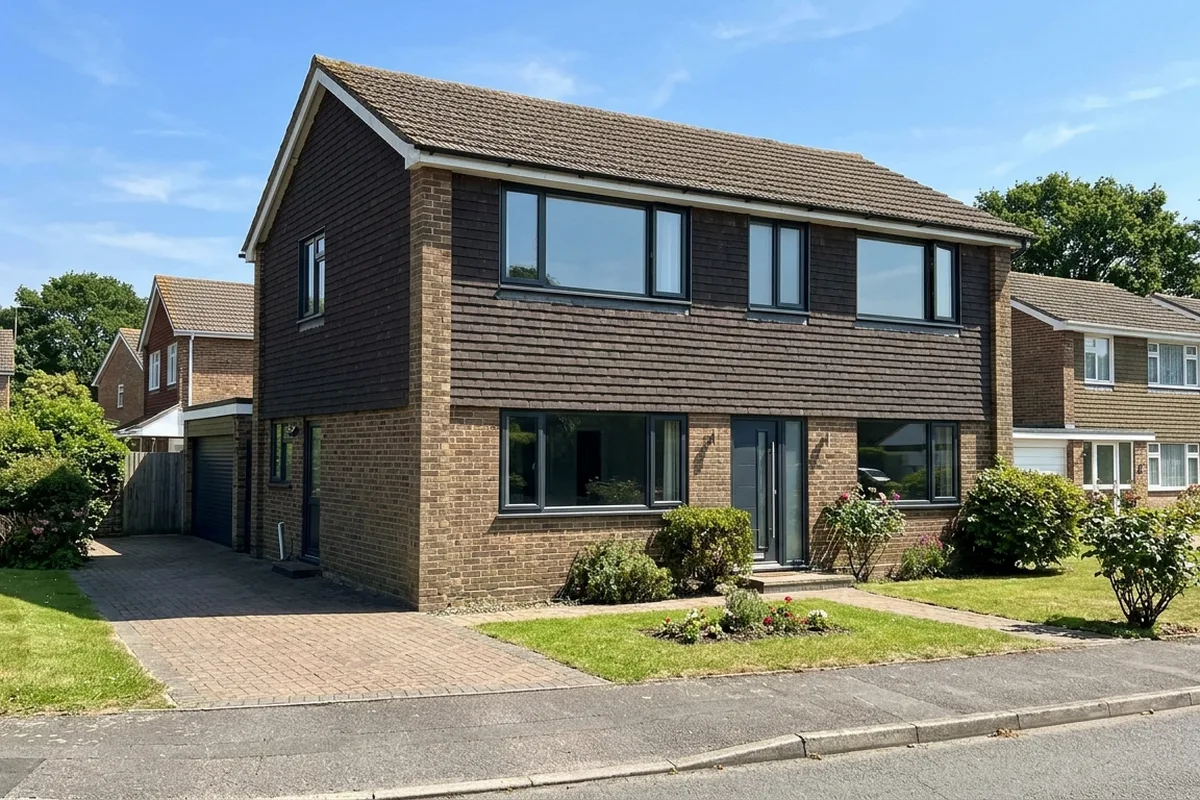
Between the 1960s and the 1990s a lot of Hassocks was filled in. Kymer Gardens and the infill off Keymer Road, Stafford Way with its green wall tiles, and the houses in The Minnels all date from those years. They were built with wide picture windows, not small upright ones.
Slimline aluminium casements suit that kind of opening. With sections of roughly 50 mm, a broad window keeps its outlook, and the powder-coated colour lasts for decades.
Compared with uPVC
Expect to pay a little over uPVC money. In return you get a thinner frame, more daylight and a far wider colour choice, which suits a 1960s house better than a Victorian one.
Compared with timber
Aluminium is cheaper than timber, and the coloured finish never wants a brush. Timber only earns its extra cost on a listed or protected house.
The later streets of Hassocks
The Hassocks Townscape Appraisal groups the later housing into its own character areas. Adastra and Kymer Gardens are 1960s and 1970s infill between the older roads. Stafford Way has houses faced with green wall tiles, an unusual touch for Sussex. The Minnels and Shepherds Walk came towards the end of the century, and the Dale Avenue and Windmill Avenue estate mixes 1930s and 1950s houses under big brown roofs.
Most of these houses were built with wide, low windows, often a large fixed pane with a narrow opener at one side or a top vent above. Many still have their first replacement units from the 1980s or 1990s, now misting between the panes and stiff on their hinges. That is the point at which slim aluminium is worth a look.
Picture windows and big panes
The strength of aluminium is that it can hold a large sheet of glass in a narrow frame. On a living-room window of two metres or more, a slimline frame gives you a clear view to the garden with only a thin line where the opener meets the fixed pane. Modern aluminium windows have a thermal break, an insulating strip inside the frame, so they meet the same energy standard as uPVC and the inside face does not run with condensation as the old single-glazed aluminium did.
Colours that suit tile-hanging and brown brick
Many 1960s Hassocks houses pair brown brick with dark tile-hanging or timber cladding upstairs. Anthracite grey is the most popular aluminium colour on houses like these, but black, bronze, dove grey and soft white all look clean. Frames can be one colour outside and white inside if you prefer a lighter room. The powder coat lasts for decades and needs only an occasional wash.
Side windows and the 1.7 metre guidance
Detached houses of this era often have bedroom or landing windows on the side wall, close to the house next door. The Planning Portal explains that new upper-floor windows in a side wall should be obscure-glazed and either fixed or opening only above 1.7 metres from the floor. Like-for-like replacement of an existing side window is a different matter from adding one, so if you plan to enlarge a side window or put in a new one, ask the council first.
Inside the conservation areas
A few later houses sit inside the Keymer or Hurstpierpoint conservation areas. On those, slim aluminium casements that resemble the windows being replaced are usually fine, but an obvious change of style deserves a call to the council first.
How the job runs
Aluminium windows are made to order from the measurements taken at the survey, which happens once you have accepted the quotation. On the day, each old frame is cut out, the opening is cleaned and packed, and each new frame is fixed, packed and sealed before work starts on the next opening, so nothing is left open at the end of the day. A typical 1960s or 1970s house with eight to ten windows takes two days. Internal sills can be replaced at the same time if the old ones are tired, and the fitters take the old frames away.
Aluminium window questions
Is aluminium more expensive than uPVC?
A little, size for size. It is cheaper than timber, and the slimmer frame gives you more glass in the same opening.
Will aluminium windows be cold?
No. Modern aluminium frames have a thermal break inside them and are double glazed, so they meet the same energy standard as other replacement windows.
Is anthracite on the outside and white on the inside possible?
Yes. Many 1960s and 1970s Hassocks houses end up with exactly that pairing, which keeps the rooms light.
Aluminium for a 1960s or 1970s house
A short call is enough to check sizes, colours and whether a slim casement suits your openings.