Hurstpierpoint windows for Georgian fronts and Victorian villas
The High Street, Hurst Wickham, Langton Lane and the roads around the College
Three conservation areas in one village
Mid Sussex designated the Hurstpierpoint Conservation Area in 1972, extended it in 1989 and again in 1999, when St Lawrence's School and part of Western Road were added. Hurst Wickham, to the east, followed in 1989, and Langton Lane, covering the lane and part of Albourne Road at the western end, in 1999.
The council's appraisal describes the High Street as narrow and tightly enclosed, with buildings from the 15th century onwards. Georgian brick fronts often hide older timber frames behind them, and many Victorian shops still have living space above.
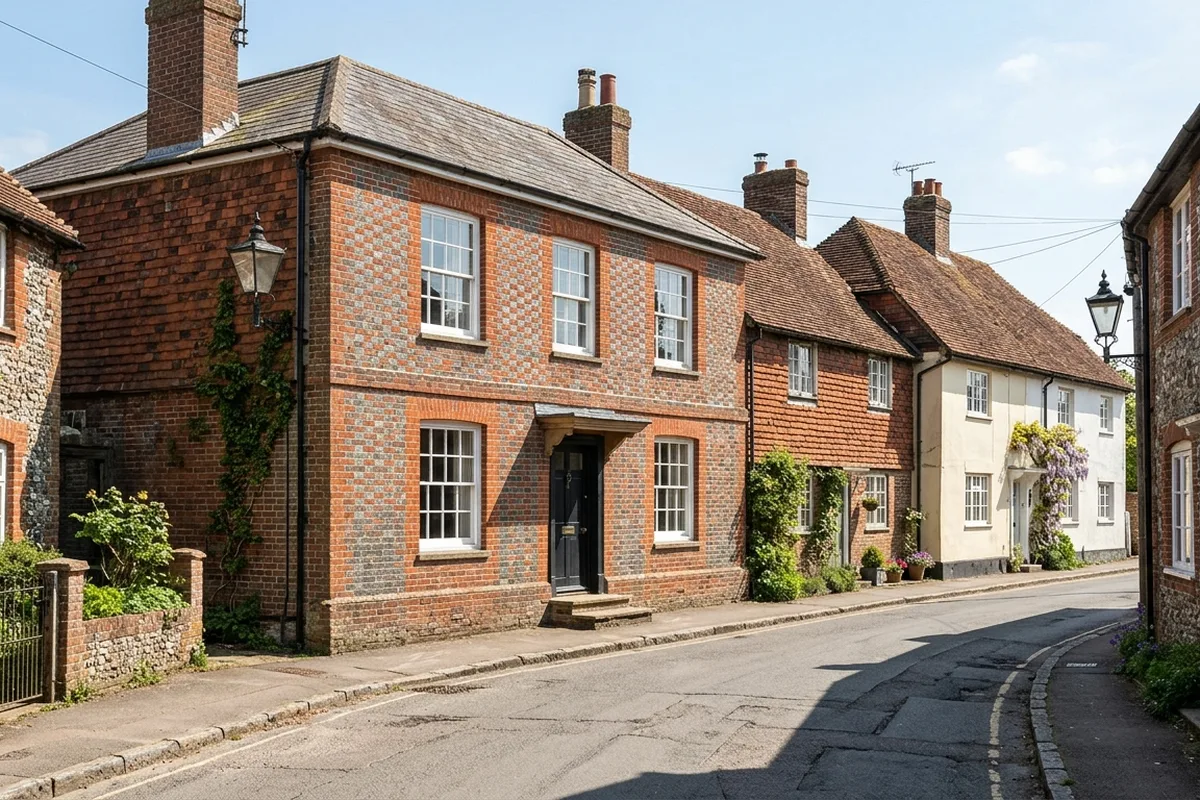
What the buildings are made of
The appraisal lists local orange and red brick, handmade clay tiles used for roofs and tile-hanging, coursed flint and cobble, weatherboarding, lime render, and bungaroosh, a mix of brick, chalk and flint set in lime. Hurst Wickham's character comes largely from College Road, narrow, with brick retaining walls, trees and hedges.
For windows, it notes timber sashes on most period houses, multi-pane timber casements, Gothic casements on the 1830s terrace in Hassocks Road, and leaded casements on the Arts and Crafts houses. It asks that original timber windows be kept wherever possible.
Windows for a house in Hurstpierpoint?
A quarter of an hour on the phone covers the house, the options and the planning position in Hurstpierpoint.
Church, College and Danny
Holy Trinity was rebuilt in 1843 to 1845 to designs by Sir Charles Barry, in a dark local stone with a stone broach spire, replacing a church recorded in Domesday Book. Hurstpierpoint College was founded by Nathaniel Woodard in 1849 as St John's Middle Grammar School, moved to the village in 1850, and its Gothic buildings by R. C. Carpenter went up through the 1850s.
South-east of the village stands Danny, an Elizabethan house carrying George Goring's initials and the date 1593. Lloyd George rented it during the First World War, and the war cabinet met there to draft the outline of the Armistice terms.
What this means for your windows
On an unlisted house in one of the three conservation areas, similar-looking replacements are usually allowed, because Mid Sussex has no Article 4 direction here. A white or cream uPVC sash in the right bar pattern often works on the Victorian houses. Listed buildings on the High Street need consent and usually timber, and the Gothic and leaded casements are best repaired or copied exactly.